
Essex County City Directory Shelves
Newark Public Library's New Jersey Room is the main local-history gateway for Newark, Essex County, and New Jersey. Its directory collection joins an early Newark run with later reverse-address, telephone, statewide, and born-digital material. The historical value is dated evidence. A listing can associate a person with a street, a household notation, or an occupation in the year printed. It cannot establish current residence, ownership, or a complete life history.
| Collection | Years | Where Held | Access |
|---|---|---|---|
| Newark city and criss-cross directories | About 1835–1964 | Newark Public Library New Jersey Room and digital collection | Online scans plus physical or microfilm copies |
| Newark and Suburban criss-cross directories | About 1972 to the current collection | Newark Public Library directory collection | Collection access; confirm the volume and year |
| Newark telephone books | Through 2019 | Newark Public Library | Collection access |
| Statewide city directories and telephone books | Nineteenth century into the 1980s; later born-digital phonebooks | Newark Public Library | Hardcopy, microfilm, reels, and later digital material |
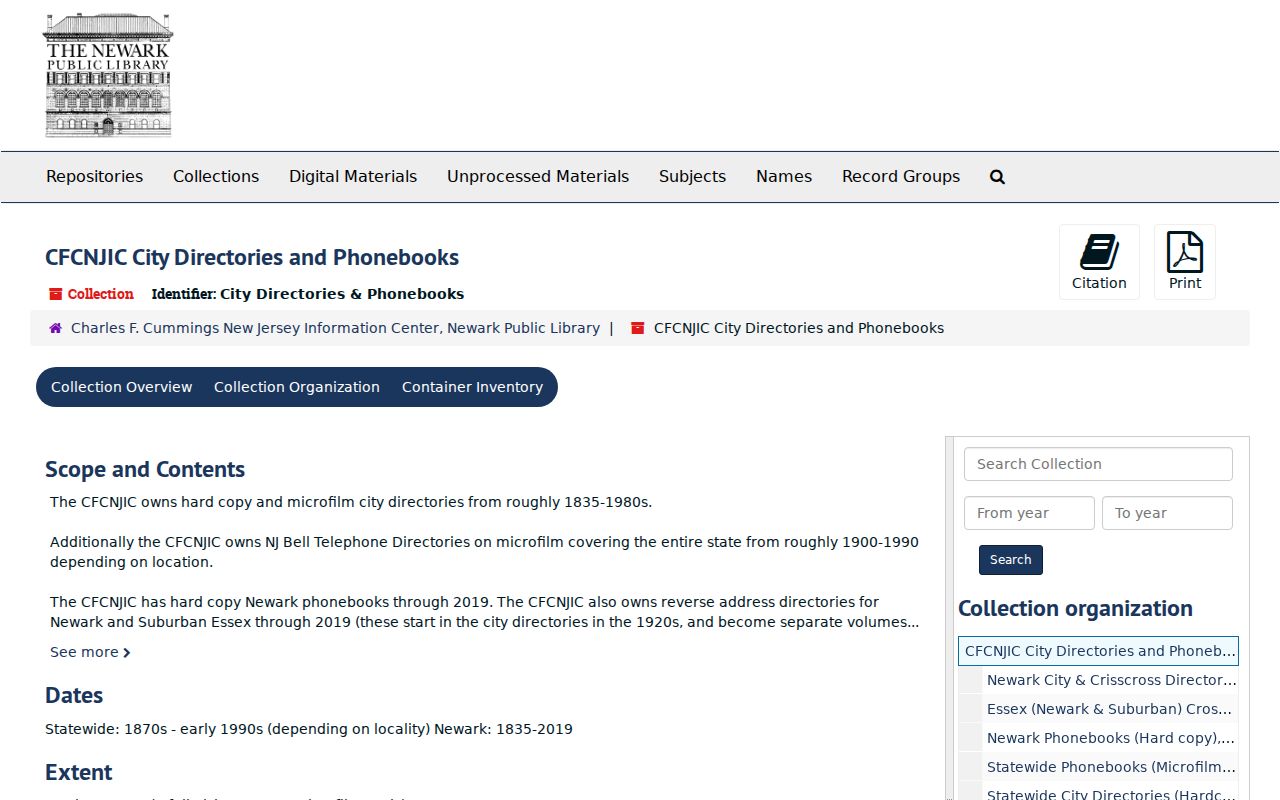
The collection record places reverse-address material inside city directories from the 1920s, then in a separate suburban and Essex series around 1972. That change matters when an address search fails in one kind of volume. Check the title, date, and arrangement before deciding that a household is absent.
Note: A directory is evidence for its printed date, not a current roster or a substitute for an official record.
Essex County City Directory Research Room
The New Jersey Room supports research-level work across books, newspapers, documents, pictures, and archives for Newark, Essex County, and New Jersey. The directory record identifies the third-floor room at 5 Washington Street in Newark and provides a direct research contact. Physical and microfilm copies matter when a scan is poor, a page is missing, or a directory series changes between years.
The Newark Public Library New Jersey Room is the local access point described by the library. Its collection scope makes the room a practical place to compare a directory entry with a telephone book, yearbook, newspaper, map, or photograph from the same period.

A visit or research request should identify the person, address, and approximate year, then leave room for staff to point to the correct series. A missing digital page is a reason to inspect the shelf or microfilm, not a finding that nobody appeared there.
Newark's Digital Directory Run
The digitized Newark collection covers 1835–1964 and is organized by year from physical and microfilm copies. Its catalog reports 104 objects, 217,243 files, and about 901.9 GB. Those numbers show the depth of the project, but they do not remove the need to check image quality, page sequence, and the year at the top of a listing.
The digitized Newark directory collection supplies text, from-year, and to-year controls for locating a volume. A precise year search is generally better than reading a result as though it covers an uninterrupted period.
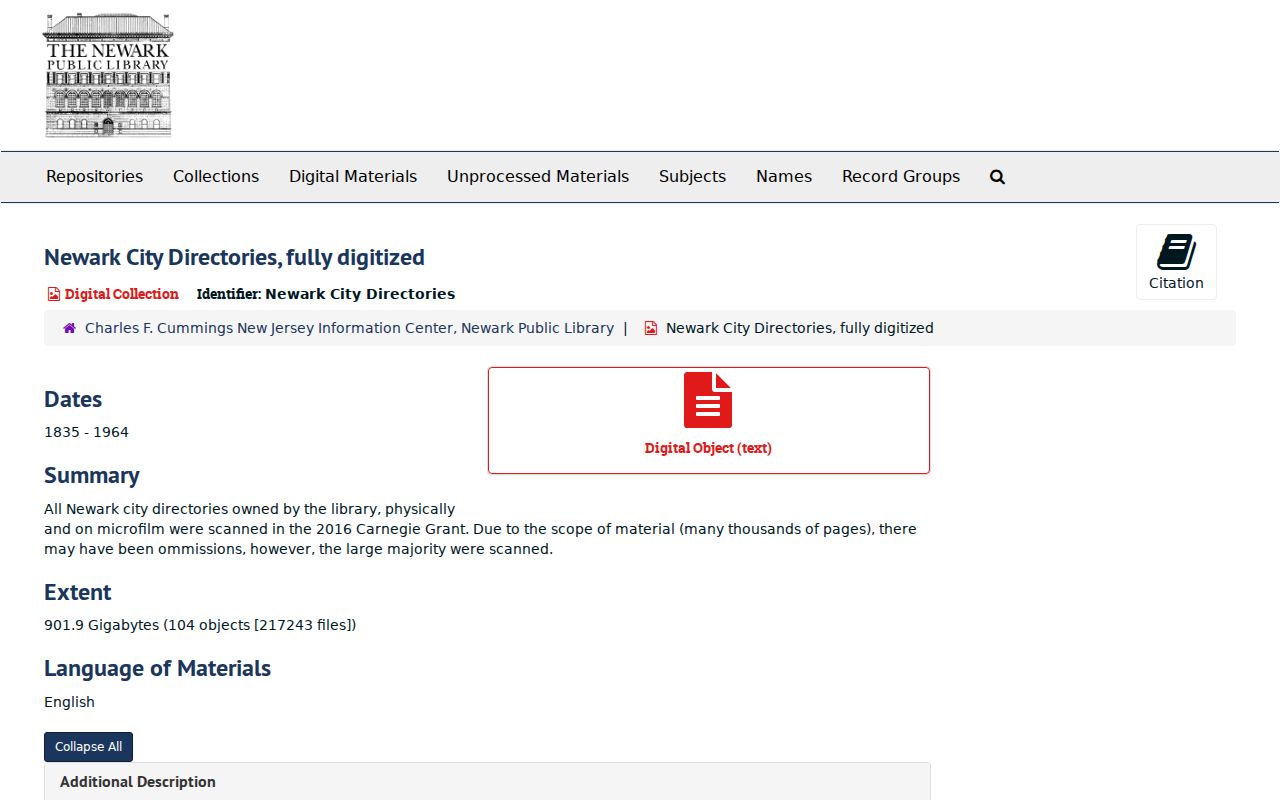
Newark's digitized run is a useful story of survival and access: a nineteenth-century directory can now be checked beside a later scan, while the physical holdings remain the fallback for gaps. That is especially helpful between federal census years.
Reading Essex County City Directory Entries
City directories may be alphabetical and street order, according to the New Jersey Historical Society's genealogist guidance. A typical entry can connect a name to an address, an occupation or business description, and sometimes a spouse or other-person notation. The exact abbreviations vary by volume. Read the introductory key before assigning a meaning to a short mark or assuming the entry describes an entire household.
| Name | The printed person or business name, including initials and spelling as the volume gives it. |
|---|---|
| Address | The listed street location, which should be checked against the date and whether the section is alphabetical or street order. |
| Occupation or business | A dated description that can distinguish same-name candidates, not proof of identity by itself. |
| Other-person notation | A spouse or household-related notation when the directory itself supplies one. |
| Street context | Nearby numbers or a reverse listing that can help test the address and neighborhood sequence. |
- Criss-cross directory
- A directory arranged by street and number, often used to find an entry from an address rather than a name.
- Householder index
- An index organized around a household or name arrangement; verify the volume's own explanation before treating it as complete.
- Abbreviation key
- The introductory guide that defines the volume's shortened words and symbols. Keep a copy of it with any extracted entry.
Note: The research did not inspect a page image for every printed abbreviation, so verify the key in the target volume.
Essex County Criss-Cross Years
Reverse-address searching is not a single, unchanging series in Essex County. Newark material began to include it inside city directories in the 1920s. Around 1972, the collection record identifies a separate Newark and Suburban or Essex criss-cross series. The shift is a useful reminder to search both the alphabetic and street-order sides of the collection when following an address.
The Newark directory collection record describes the city, criss-cross, telephone, statewide, and born-digital series together. Use that record to select the format, rather than assuming a telephone book or a street listing reports the same role as a directory entry.
Street order can reveal nearby numbers, a different spelling, or an institution. It does not establish that the named directory resident owned the property, and it should not be used to infer a current occupant.
Essex County City Directory Timeline
Directory research works best when the publication history stays visible. Essex records divide between printed books, microfilm, scanned copies, and later telephone or born-digital material. A gap may reflect a change in the series, an unscanned volume, an image problem, or an arrangement that moved from alphabetical to street order.
- 1835: Newark's digitized city-directory run begins.
- 1920s: Reverse-address material begins within Newark city directories.
- 1964: The digitized Newark directory run ends.
- About 1972: A separate Newark and Suburban or Essex criss-cross series begins in the collection.
- Later holdings: Newark telephone books continue through 2019, while statewide and born-digital materials extend the shelf in different formats.
Library scans do not create a seamless countywide directory. Essex has 22 municipalities, and Newark's rich collection should not be presented as proof that every municipality has the same coverage.
Essex County Directory Companions
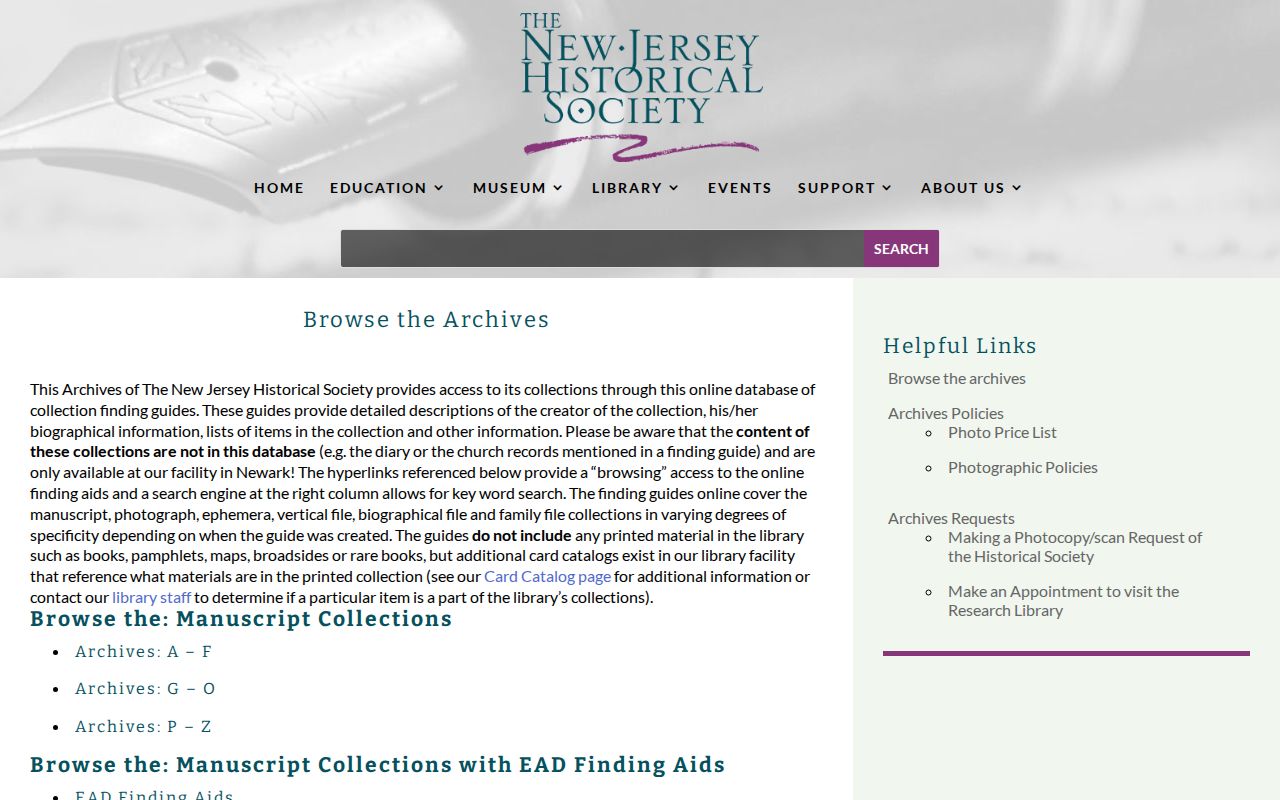
The New Jersey Historical Society adds local histories, vital and church records, newspapers from 1777 onward, maps, city directories, and more than 2,000 maps. Its genealogical resources include family and church material, estate and family files, and on-site finding aids. Fragile, rare, oversized, or copyrighted material can have access limits, so a research request may be more useful than trying to reproduce every page.
The New Jersey Historical Society archives offer finding aids for material that often remains on site. Pairing a directory with a map, newspaper, church item, probate source, or census image gives an old address context without turning one listing into a biography.
For a historical name, use the same spelling and initials in each source first. Then record the source date, collection, page or image, and whether the evidence is an index, an image, or a staff-mediated copy.
The 1930s Newark Directory Shelf
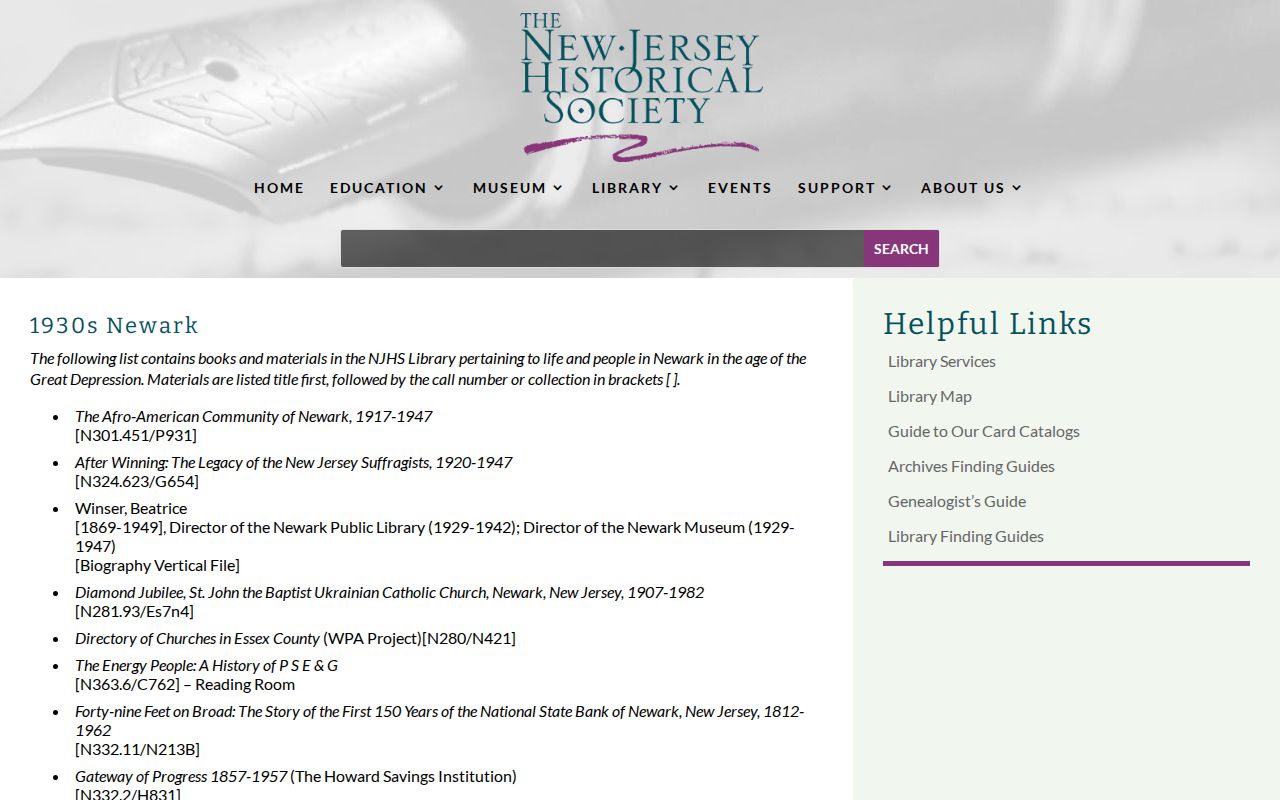
The Historical Society's 1930s Newark collection is unusually specific. It brings together Newark directories for 1930, 1931, 1932, 1934, 1935, 1936, and 1939, Sanborn maps for 1930 and 1931, Woodland Cemetery records, selected industrial directories, a WPA church directory, newspapers, and 1930 census figures. That mix can test a name or street in its own decade instead of using a generic history.
The 1930s Newark holdings show how a directory can become the first step in a deeper local record trail. A map can clarify a block, a newspaper can add a dated public event, and a census image can place the household on an enumeration day.
This is a numbers-and-story collection, not a proof machine. Each source keeps its own date, scope, and possible errors, so a researcher should preserve what was actually inspected.
Trace Essex County City Directories
Follow a household one dated source at a time. Start with the earliest known name or address, search the annual alphabetical section, and then check the street or criss-cross portion where available. A person can appear under a nickname, initials, translated name, maiden name, or a changed street number. Census images are snapshots, so directory years are especially useful for checking movement between releases.
- Choose a year close to a documented life event and search the alphabetical directory for the spelling in hand.
- Record the exact printed name, address, occupation or business description, and every notation from the entry.
- Check the same address in the street-order or criss-cross material, without assuming a listed person was an owner.
- Move forward and backward through nearby years, preserving each change in address, spelling, or directory arrangement.
- Compare a surviving run with a census image, map, newspaper, probate record, or State Archives collection.
A name that disappears may mean a move, death, omission, changed spelling, missing page, or a different directory type. Label the result as not found in the searched source, then state the years and pages actually checked.
Essex County Directory Limits
Newark Public Library and the Historical Society preserve deep materials, but access is uneven across the county. The Essex Historical Society has business, industry, maritime, map, photograph, postcard, home, and family-history materials, yet its name refers to the Town of Essex in a different municipal scope. Confirm that a collection item concerns the relevant Essex County municipality before treating it as local evidence.
The Essex Historical Society collections describe these local-history holdings and research assistance. Their municipal scope is a research question, not an assumption.
Use a dated directory as a lead, then verify an important conclusion with the custodian that holds the record. For present-day address or parcel work, the Essex County street directory takes a different, address-keyed route.
Note: A blank, blurred, or missing scan is a collection gap, not negative proof about a person or place.