
Essex County Address History Sources
One Essex County address can produce land, directory, census, map, probate, and newspaper leads. The source to start with depends on the period and the question. Recorded land documents identify parties and the date of a transaction. Directories can place an occupant or business at an address in a given year. Census and archival records add household and family context, but neither replaces the legal description in a recorded instrument.
| Source | Years It Covers | Where Held | What It Shows |
|---|---|---|---|
| PRESS remote deed index | From 10/01/1996 | Essex Register PRESS | Indexed instruments by municipality, block/lot, name, document type, and date. |
| Register record collections | Records from 1637; computerized index since December 1988 | Public Vault / Record Room | Older books, indexing help, recorded document access, and copy follow-up. |
| Newark city directories | About 1835–1964 | Newark Public Library, including digitized collection | Names, addresses, street-order entries, and period context. |
| Essex crisscross directories | Street material from the 1920s; separate series about 1972 onward | Newark Public Library holdings | Address-oriented entries for historical occupants or businesses. |
| Federal census | Public schedules through 1950 | National Archives and library research channels | A household snapshot for an enumeration day. |
| NJ State Archives collections | Series vary; births 1848–1925, marriages and deaths through 1950 | New Jersey State Archives | Genealogical, probate, naturalization, chancery, and historical county material. |
Municipal permits and code files can add building history, but coverage and access vary across Essex County's 22 municipalities. A Newark example cannot establish what another municipal office holds. For a non-Newark address, first identify the municipality's clerk, assessor, building office, and records custodian before treating a missing result as a gap.
Essex County Address Records Begin With a Parcel
Before following past residents, stabilize the address. Preserve the supplied address and any historic form separately from a normalized mailing form. Then record the civil municipality, street address, situs address, block, lot, and PAMS PIN where the parcel layer provides them. The situs address is the parcel's physical location. A tax mailing address may be somewhere else, and neither one proves who lived there.
The NJGIN parcel guidance explains that counties and municipalities maintain the source parcel data and the state publishes composites. The polygons are not legal surveys, and Daniel's Law can suppress an owner name in state-hosted products. That makes the map a location and identifier tool. Use the Register's land records or the municipal assessor to test a title or assessment question.
See the Essex County Register of Deeds and Mortgages before deciding which access channel fits the address history.
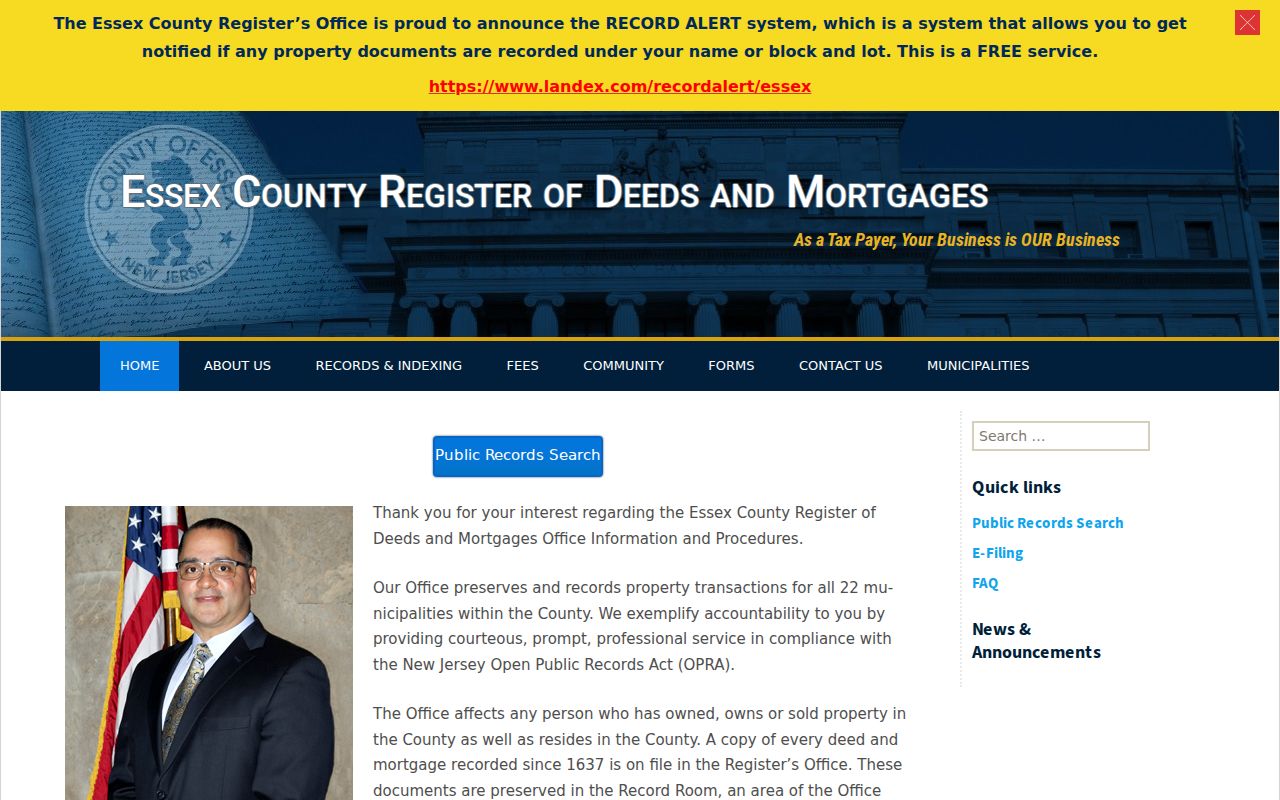
The Register serves land transactions across all 22 municipalities, while assessor and building records remain municipal. Record the municipality before moving from a parcel map into the deed index.
Trace Essex County Land Records Through PRESS
For property history, the Essex Register's PRESS system is the main remote index. It offers instrument, book-and-page, document-type, block-and-lot, and name searches. In block-and-lot mode, municipality, block, and lot are required. Name mode requires a last or company name and accepts an optional first name. The remote-search coverage statement begins October 1, 1996, and a query date range cannot exceed 90 days.
- Resolve the address to its municipality, block, and lot, then save the PAMS PIN and parcel location as separate clues.
- Search PRESS by municipality, block, and lot for the most recent recorded instruments. Log the date window and exact query.
- Open the result details and record the instrument number, book/page if shown, recording date, document type, and each indexed party role.
- Use the earlier party and the same parcel identifiers to search backward. Split multi-year work into 90-day windows.
- When remote coverage ends or an image is unavailable, continue in the Public Vault or Record Room rather than assuming the prior record does not exist.
A grantor transfers an interest in a recorded instrument. A grantee receives that interest. Neither label alone proves that person lived at the property. A chain of title is the sequence of recorded ownership interests for land, and the legal description is the recorded land description that can remain useful when a street address changes.
Inspect the Register's records and indexing guidance for the office's access notes and document vocabulary.
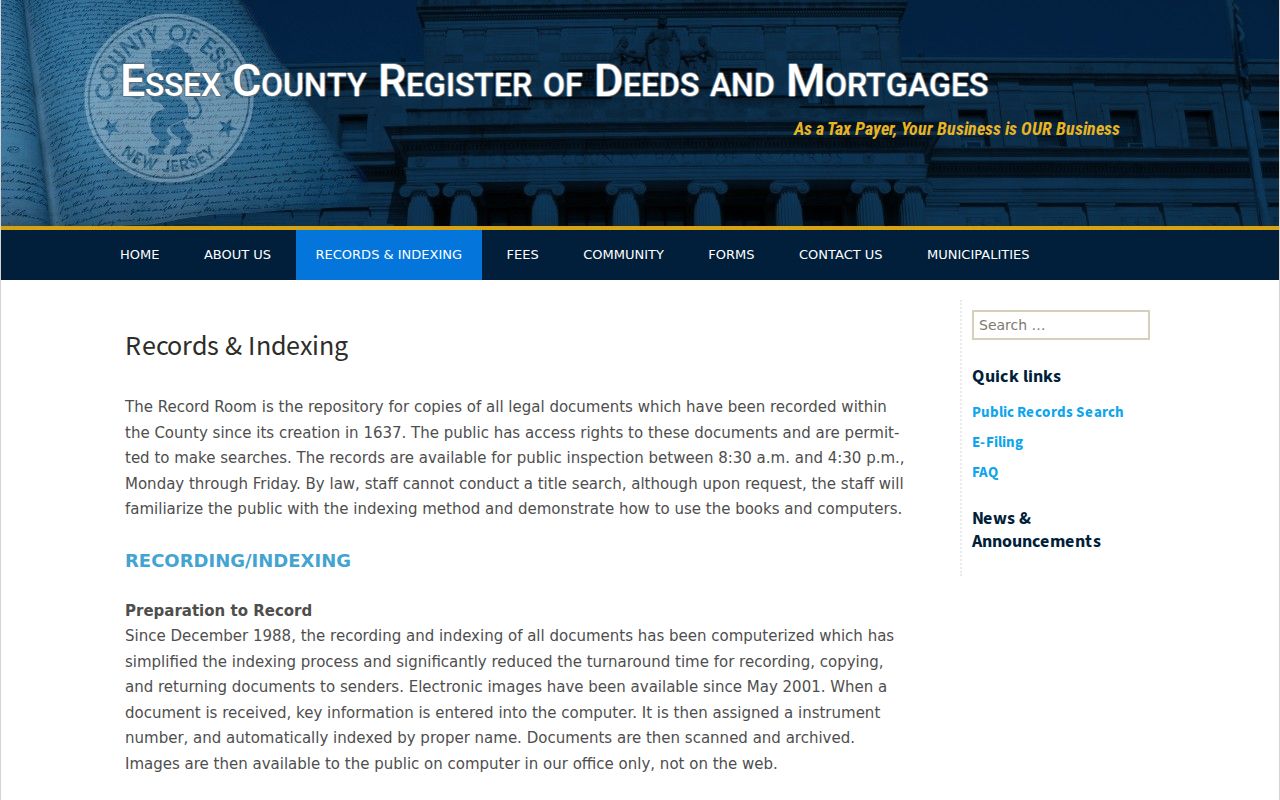
PRESS is an index and availability tool, not a title search. A deed, mortgage, release, notice of settlement, lien, map, or tax-sale record has a different role in the history, so each result needs its own label.
Essex County Record Room Access
The Register states that the Record Room preserves records from county creation in 1637 and that its indexing became computerized in December 1988. Older material and some image follow-up belong in the Public Vault or Record Room. The Register says staff can explain the indexing system and demonstrate books or computers, but the office does not perform title searches for the public. That boundary matters when a deed chain reaches an old book or has a gap in online image access.
A present address can open a much older record path, but the path should move one dated event at a time. Do not jump from a current parcel owner to an older name merely because it appears nearby in an index. Deeds may transfer an interest through an estate, trust, entity, mortgage event, or other transaction that is not an ordinary sale.
Use the Register forms page for the current recording-related forms and request route.
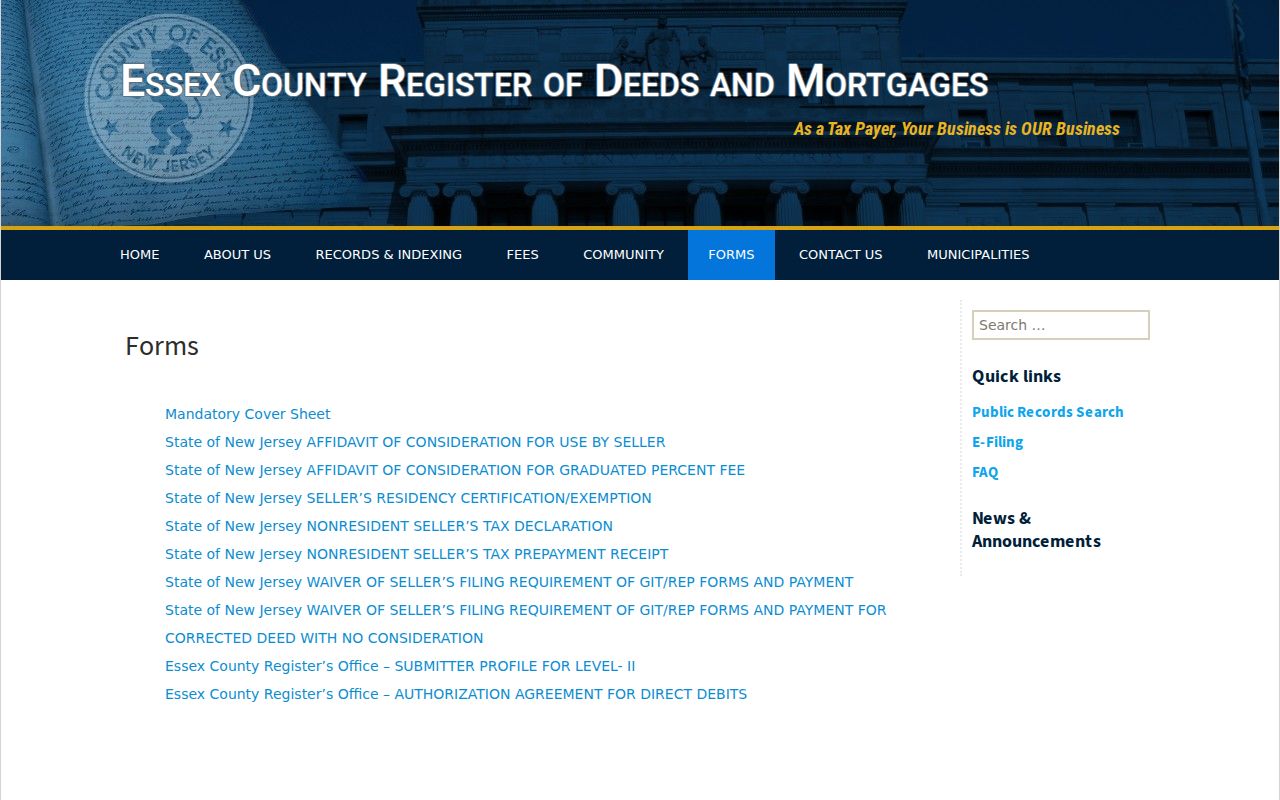
Forms and recording procedures help identify the right transaction channel. They do not turn a request into a private-person history or guarantee that a particular record is available.
Note: Log whether each Essex County result came from an index, an image, a copy, or a certified copy before relying on it.
Essex County Deed Copy Status
The kind of document inspected changes what can safely be concluded. A parcel card is a map and tax-data lead. A PRESS hit is an index entry. An image may show the recorded document, while a certified copy is an official copy obtained through the custodian. When the conclusion depends on the legal description, parties, consideration, or signature, inspect the instrument or request the appropriate official copy rather than relying on a result list.
The Register fee schedule separates charges by document type and page structure. It should be checked at the time of a request because the exact charge depends on the instrument and pages. The research does not support a single flat fee for an Essex deed-history request.
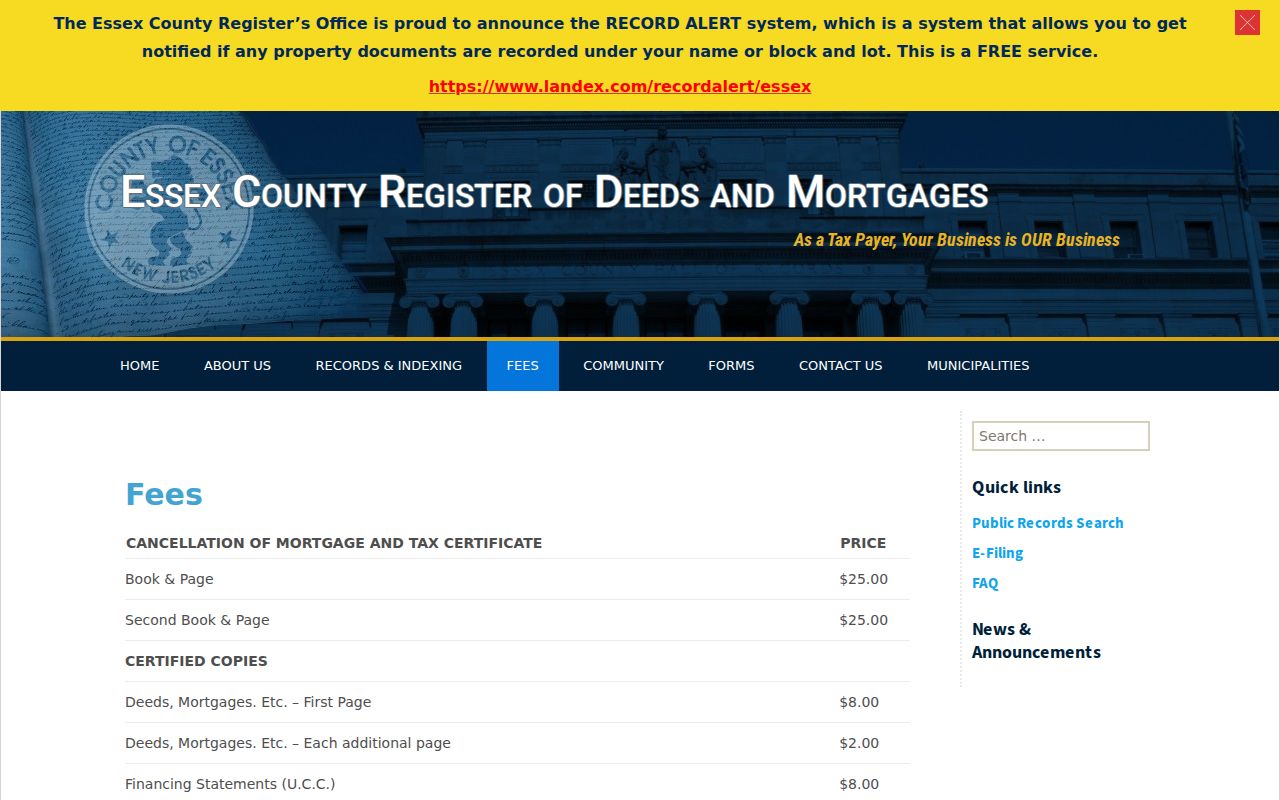
Keeping index, image, and certified-copy status in the research log prevents a summary from claiming more certainty than the document actually supplies.
Essex County Directory Occupants
Past residents are the household side of the address trail. Newark Public Library's New Jersey Room holds Newark city and crisscross directories from about 1835 through 1964. Reverse-address material began inside city directories in the 1920s and became a separate Essex or Newark-and-Suburban series around 1972. The digitized Newark directory collection covers 1835–1964, while physical and microfilm holdings help with a weak scan, missing page, or later run.
A directory entry can join a name to an address, occupation or business description, spouse or other-person notation, and street-order context. Read the volume's abbreviation key before interpreting an entry. A person can appear as an occupant, business contact, telephone subscriber, or street listing for different reasons. A directory listing is historical evidence for an address and year, not proof of current occupancy or ownership.
The digitized Newark directories are organized by year and report 104 objects and more than 217,000 files. The size of the collection is a useful local-history resource, but a missing page remains a research gap rather than negative proof.
Essex County Census Pairing
Pair directory years with census years instead of treating either source as continuous. The federal census schedules are public through 1950 under the 72-year rule. A census entry can include a name, age, relationship to the household head, birthplace, naturalization status, and other period questions. It is a snapshot on an enumeration day, and its district may not match a modern ZIP, municipal line, or street number.
- Find the address in an alphabetical and street-order directory for a year close to a census.
- Record the address form, nearby street numbers, household clues, and all directory abbreviations.
- Search the relevant census year, ward or township, and adjacent enumeration districts using the address and name variants.
- Compare age, household role, birthplace, and street information with the directory, not with a surname alone.
- Check a nearby directory year, newspaper issue, deed, or map when the address appears to change or the household is absent.
The National Archives census portal explains the federal census research route. An absence can reflect an unsearched ward, nickname, spelling difference, boundary change, or a person being away on enumeration day.
Essex County Historic Street Numbers
Renumbering can mimic a move. A historic address may use a different number, street spelling, cross street, ward, or municipal description from its current form. Compare directory street order, nearby numbers, city maps, Sanborn maps, parcel descriptions, and the legal description before deciding that a household left the property. The research found Newark Sanborn maps for 1930 and 1931 in the New Jersey Historical Society's 1930s collection.
That collection also combines Newark directories for 1930, 1931, 1932, 1934, 1935, 1936, and 1939 with newspapers, cemetery records, church material, industrial directories, and census figures. It supports a period-specific address story without turning one old listing into a claim about every person who lived there. Link the title, date, and page for a newspaper item instead of repeating sensitive family details.
Essex County Archive Research
Probate can connect an estate, heirs, property description, executor, and date of death. It does not replace a deed. Compare the property details with the Register's instrument index and parcel identifiers. The New Jersey State Archives identifies Essex naturalizations and County Surrogate books beginning in 1804, along with historical vital, probate, chancery, and county material. Its guidance also warns that early birth records and ledgers can be incomplete.
Newspapers and obituaries can add a dated event, but should be treated as leads that can repeat an error. Keep the publication title, date, page, and exact spelling. The strongest backward sequence usually runs directory to census to newspaper to vital or genealogical material to probate, with a second identifying clue at every transition.
Consult the New Jersey State Archives genealogical collections for the historical series and access guidance.
The Archives is a historical bridge when a present address reaches beyond PRESS or the digitized directory years. State holdings and a municipal record should still be checked against their own coverage notes.
Essex County Lawful History Use
House history, family history, estate research, and civic curiosity are appropriate reasons to keep a dated source trail. New Jersey records can also contain protected or redacted information. Daniel's Law can suppress covered-person addresses in state-hosted parcel products, and the Address Confidentiality Program can use a substitute address for qualifying participants. A blank field, absent index result, or missing scan is not evidence that nobody lived at an address or that a record never existed.
Keep the scope of each source plain: parcel map, assessment record, index, image, certified copy, directory, census, or archival lead. That small discipline protects both the accuracy of a previous-resident search and the people connected to its records.